X-Ray Crystallography
Access:
Atomic-resolution structures from protein crystals
X-ray crystallography determines three-dimensional atomic structures from diffraction patterns produced when X-rays pass through crystalline samples. The technique remains essential for structural biology, delivering high-resolution snapshots of proteins, nucleic acids, and complexes that define mechanism and enable structure-based drug design. Recent advances in synchrotron instrumentation and data collection methods have dramatically improved throughput and reduced sample requirements, making crystallography more accessible for a broader range of biological systems.
NYSBC operates the NYX beamline at NSLS-II (Brookhaven National Laboratory), a state-of-the-art macromolecular crystallography facility optimized for high-throughput data collection and automated sample handling. The beamline supports both standard and specialized experiments, including in-cell and time-resolved crystallography. NYSBC members receive allocated beam time; national researchers access the beamline through the NSLS-II proposal system or via proprietary arrangements with NYSBC.
Access
MEMC/Member Institutions
NYSBC members receive allocated beam time each year. Request access through the NYX scheduling system [link]. Beam time is available on a calendar-based cycle; scheduling is typically limited to the current operations cycle.
National Access (NSLS-II Proposal Process)
Non-member researchers can request beam time through NSLS-II’s standard proposal process. Proposals are reviewed on scientific merit and scheduled according to NSLS-II policy.
Proprietary Access
Proprietary users can arrange access through contract with NYSBC or via the NSLS-II proposal process. Both member and proprietary users can schedule beam time on short notice or arrange regularly scheduled sessions.
Technology
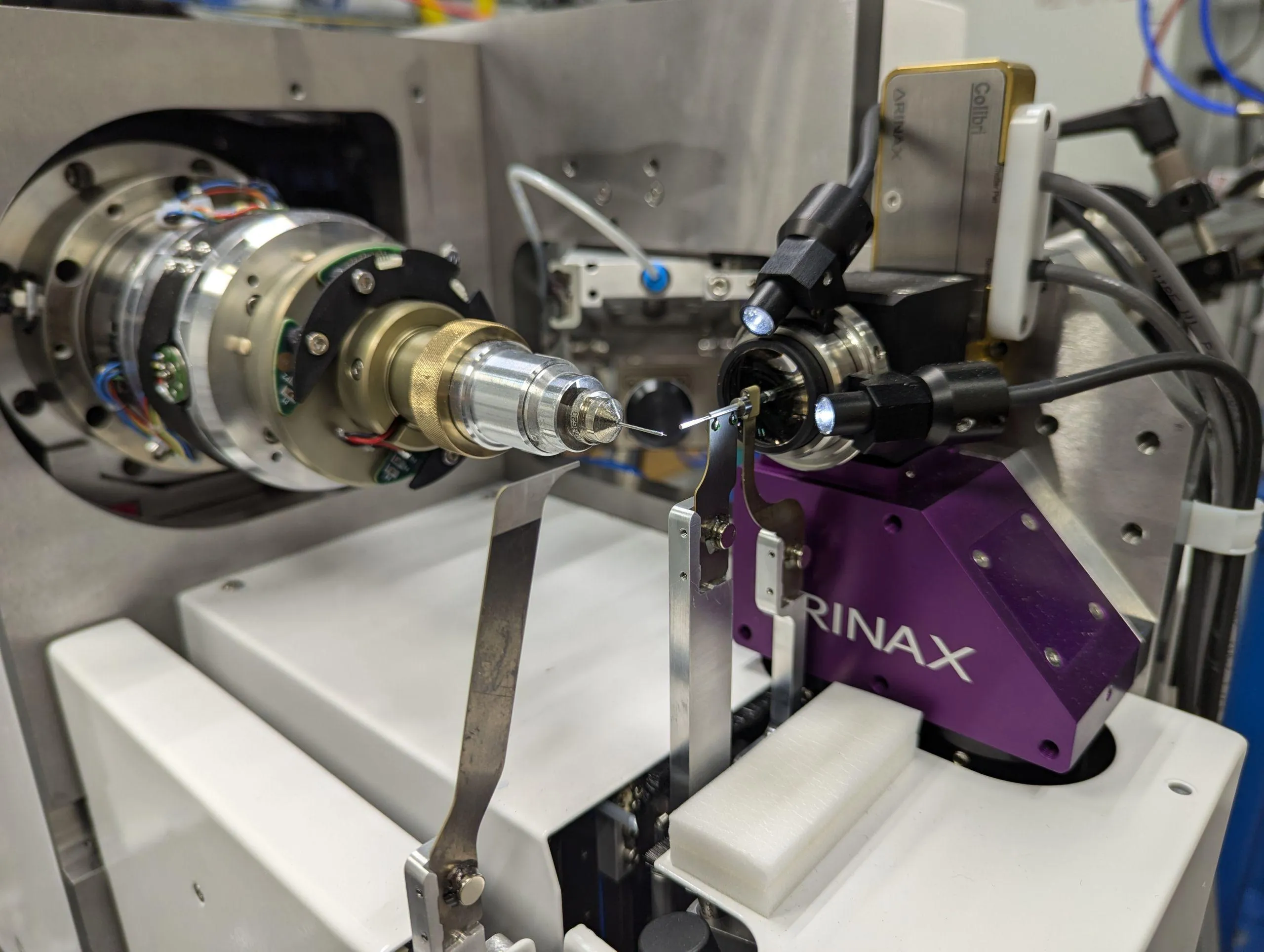
The beamline is equipped with modern experimental equipment to support synchrotron data collection.
Irelec ISARA2 sample mounting robot
29 UniPuck capacity with any common metal baseArinax MD-2s goniometer system
Dectris Eiger2 XE 9M detector
10 node processing cluster
Experimental capabilities:
Single point and vector data collection
Raster/grid scan
Automated screening and data collection
Automated data processing and structure solution
Remote, on-site or mail-in access modes available
In situ collection in crystallization plates coming soon


User Resources
-
- Notify NYX staff of your intent to register as a user:
- Let us know if you will be remote, on site, or both.
- Request the proposal number.
- Wait until you have confirmation from the staff before moving to step 2.
- Register as a user with the BNL Guest Information system for site access: https://guest.bnl.gov
- Purpose of visit: User
- Name of host: Kevin Battaile
- Department: NSLS 2 Facility Users (LTU)
- Research facility: NSLS2
- NOTE: Wait until step 2 is done before moving to step 3. The lab recommends registering 30 days in advance of your visit date. It may take in excess of 45 days for foreign nationals to have their appointment approved.
- Request a BNL computer account: https://www.bnl.gov/accounts
- Install DUO Security on your mobile device:
- Register with DUO Federal: https://duo-fed-enroll.bnl.gov
- Install the Omnissa Horizon Client: https://customerconnect.omnissa.com/downloads/info/slug/virtual_desktop_and_apps/omnissa_horizon_clients/8
NOTE:
- A VPN is no longer required to access lab computer resources.
- NoMachine is no longer supported.
- Access to your data requires a current guest appointment at BNL. If your appointment expires, your data access is lost.
- Notify NYX staff of your intent to register as a user:
-
-
-
-
-
Publications
Near UV Photo-Degradation of IgG1-Fc Promoted by His and Fe(III): Probing the Role of the Metal-Binding Pocket by Site-Directed Mutagenesis
Molecular Pharmaceutics
Crystal structure of Plasmodium vivax macrophage migration inhibitory factor
Acta Crystallographica Section F Structural Biology Communications, Vol. 82, Issue 6, Pages 194-200
Structure-Guided Design of Calcium-Dependent Protein Kinase 1 Inhibitors for Cryptosporidiosis
The Journal of Infectious Diseases
Structural analyses of Trichomonas vaginalis pyrophosphate-dependent phosphofructokinase (TvPPi-PFK)
A Trichomonas vaginalis C2-XYPPX-repeat protein with a structured C2 domain displaying dampened flexibility upon binding calcium
Biochimie, Vol. 241, Pages 44-55
Structure, Function, and Inhibition of Adenylosuccinate Lyase (ADSL) from Mycobacterium tuberculosis
ACS Infectious Diseases, Vol. 12, Issue 1, Pages 74-90
Structural Analysis and Inhibitor Modeling of Bacterioferritin From Brucella abortus.
Proteins, Vol. 94, Issue 6, Pages 1170-1181
Discovery and mechanism of a highly selective, antifungal acetyl-CoA synthetase inhibitor
Nature Communications, Vol. 16, Issue 1
Inhibitors of the Bacterioferritin Ferredoxin Complex Dysregulate Iron Homeostasis and Kill Acinetobacter baumannii and Biofilm-Embedded Pseudomonas aeruginosa Cells
ACS Infectious Diseases, Vol. 11, Issue 7, Pages 1983-1993
Crystal structure of N-terminally hexahistidine-tagged Onchocerca volvulus macrophage migration inhibitory factor-1
Acta Crystallographica Section F Structural Biology Communications, Vol. 80, Issue 12, Pages 328-334
Structures of Trichomonas vaginalis macrophage migratory inhibitory factor
Acta Crystallographica Section F Structural Biology Communications, Vol. 80, Issue 12, Pages 341-347
A single Leishmania adenylate–forming enzyme of the ANL superfamily generates both acetyl- and acetoacetyl-CoA
Journal of Biological Chemistry, Vol. 300, Issue 11, Pages 107879