NMR Research
Advancing NMR measurement of biomolecular dynamics

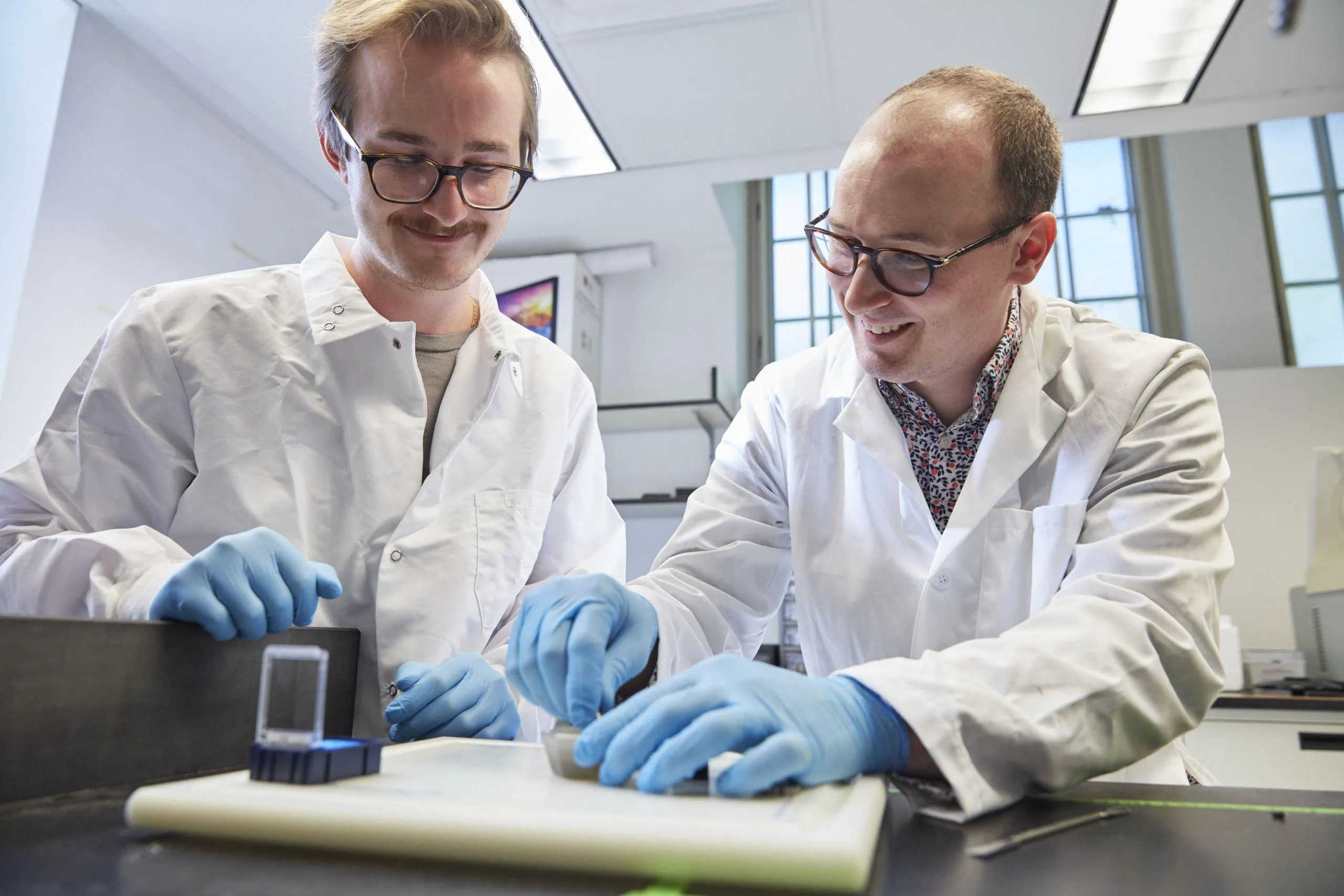
NMR research at NYSBC sits at the intersection of methods development and biological discovery. Staff scientists are active contributors to CoMD/NMR (the NIH-funded Center on Macromolecular Dynamics by NMR Spectroscopy), which develops, validates, and disseminates NMR methods for studying biomolecular dynamics and structure. This dual focus—developing new experimental and analytical tools while applying them to fundamental biological questions—allows NYSBC to identify bottlenecks, test innovations, and share advances with the broader research community.
Research themes span solution-state and solid-state NMR, dynamic nuclear polarization, high-resolution relaxometry, and the development of new probe technologies and pulse sequences. Recent capabilities include North America’s only 800 MHz MAS cryoprobe and the Bruker Fast Shuttle system (to be installed in 2026), both of which expand the range of experiments that examine conformational dynamics, protein folding, enzyme catalysis, and molecular recognition. Staff scientists work directly with users on experimental design and analysis, co-authoring publications and serving as active collaborators on projects from member institutions and national users.


Publications
Direct Determination of Protein Rotational Diffusion Tensors and Generalized Order Parameters from Multifield 15N NMR Spin Relaxation
Journal of the American Chemical Society, Vol. 148, Issue 26, Pages 27030-27034
Structural studies of an antinecroptosis viral:human functional heteroamyloid M45:RIPK3 using SSNMR
Proceedings of the National Academy of Sciences of the United States of America, Vol. 123, Issue 18
Water-mediated reconfigurable topology and mechanics in porous peptide materials
Matter, Vol. 9, Issue 4, Pages 102669
A steady-state approach for analysis of high-resolution relaxometry
Journal of Magnetic Resonance, Vol. 381, Pages 107989
Probing rare and short-lived conformational states in nucleic acids using off-resonance carbonyl and guanidino carbon R<sub>1ρ</sub> relaxation dispersion.
Journal of magnetic resonance (San Diego, Calif. : 1997), Vol. 377, Pages 107910
Binding of small molecules at the P-stalk site of ricin A subunit trigger conformational changes that extend into the active site.
The Journal of biological chemistry, Vol. 301, Issue 3, Pages 108310
Parsing Dynamics of Protein Backbone NH and Side-Chain Methyl Groups using Molecular Dynamics Simulations
Journal of Chemical Theory and Computation, Vol. 20, Issue 14, Pages 6316-6327
Deuterium spin relaxation of fractionally deuterated ribonuclease H using paired 475 and 950 MHz NMR spectrometers.
Journal of biomolecular NMR, Vol. 78, Issue 3, Pages 169-177
Breaking down walls: Continuous potential models for internal motions in NMR spin relaxation
Journal of Magnetic Resonance, Vol. 363, Pages 107705
<sup>1</sup>H, <sup>13</sup>C, and <sup>15</sup>N backbone and methyl group resonance assignments of ricin toxin A subunit.
Biomolecular NMR assignments, Vol. 18, Issue 1, Pages 85-91
Calcium mediated static and dynamic allostery in S100A12: Implications for target recognition by S100 proteins.
Protein science : a publication of the Protein Society, Vol. 33, Issue 4
Controlling Hydrophobicity of Colloidal Silica to Promote Miscibility in Polymer Nanocomposites
Macromolecules, Vol. 57, Issue 10, Pages 4963-4977